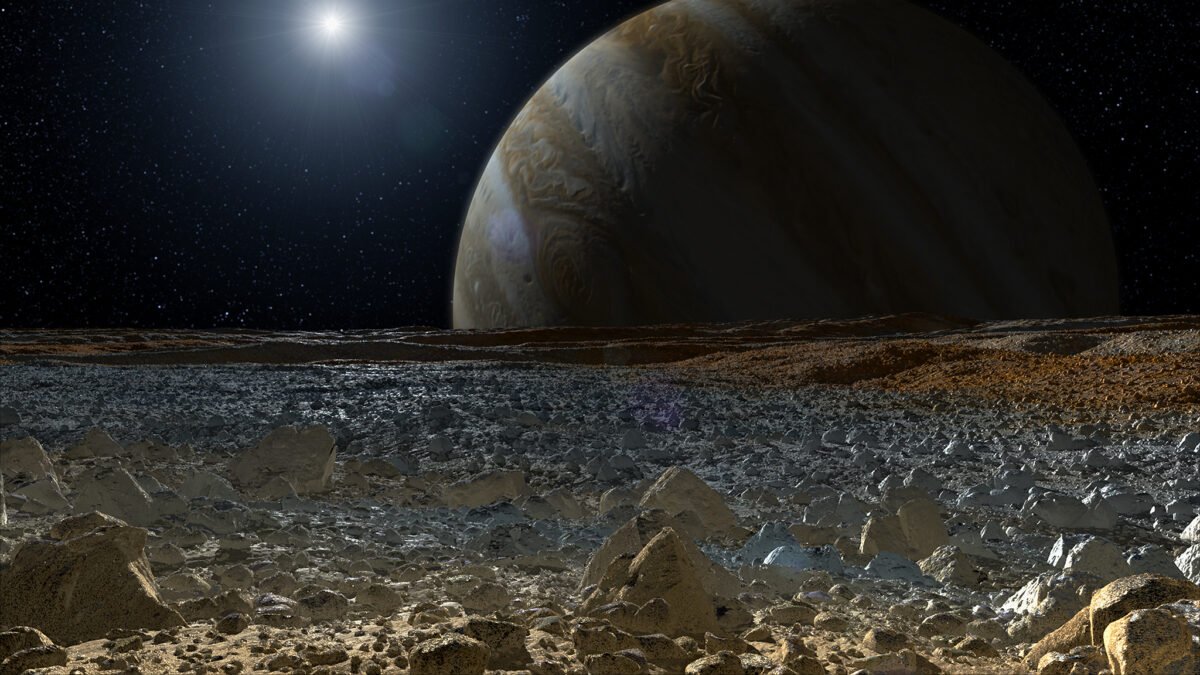


Is there life in Europa’s ocean?
Short answer, nobody knows yet. But a January 2026 study made the possibility look a lot more plausible than it did even a year ago.
For context if you’re not up to speed on Europa, it’s one of Jupiter’s moons and it has a global liquid ocean hiding under a frozen surface. We’ve known about the ocean since the 1990s thanks to NASA’s Galileo spacecraft. This ocean holds roughly twice the volume of all Earth’s oceans put together. It stays liquid because of tidal heating from Jupiter’s gravity constantly squeezing and stretching the moon.
The big question has always been whether anything could actually survive down there. It’s dark, it’s cold, it’s under miles of ice.
New Insights into Europa Ocean Life Evidence Discovery
While humanity looks toward the stars, the Europa Ocean Life Evidence Discovery of 2026 has brought our focus closer to home, suggesting that Jupiter’s moon might be more hospitable than we ever imagined.
The January 2026 study modelled what happens when the salts sitting on Europa’s surface interact with the ice shell. Here’s the key finding, salty brine-laden ice is denser than the surrounding pure ice, so over geological time it sinks downward through the shell and eventually reaches the ocean below.
Why does this matter? Europa’s surface gets bombarded with radiation from Jupiter’s magnetosphere. That radiation creates oxidants, things like hydrogen peroxide and various oxygen compounds. If those oxidants can hitch a ride on sinking ice down to the ocean, they could provide chemical energy for microbes. No sunlight required.
Previous models had basically treated the ice shell as a sealed lid, locking all the interesting chemistry at the surface where nothing can use it. This new work suggests it’s more like a very slow conveyor belt moving material downward over millions of years. That changes things considerably.
Potential Organisms in Europa Ocean Life Evidence Discovery
While humanity looks toward the stars, the Europa Ocean Life Evidence Discovery of 2026 has brought our focus closer to home, suggesting that Jupiter’s moon might be more hospitable than we ever imagined.
Not fish, that’s for sure. We’re talking simple microbes, probably similar to the extremophiles that cluster around hydrothermal vents in Earth’s deep oceans. Those ecosystems run entirely on chemical energy and never see a ray of sunlight.
Europa may well have its own hydrothermal vents where the ocean floor meets the rocky mantle. If so, potential life would have two energy sources working in its favour, chemical fuel dripping down from above and geothermal heat pushing up from below. Either one alone is interesting. Both together is a much stronger case.
When Will We Actually Know?
NASA’s Europa Clipper launched in October 2024 and gets to Jupiter in 2030. It’ll do dozens of close flybys, mapping the ice and looking for water vapour plumes shooting through surface cracks. ESA’s JUICE mission arrives in 2031.
Neither spacecraft will land or drill through the ice, so don’t expect a definitive answer right away. But they might find enough indirect evidence to justify sending a lander later on. Patience is kind of mandatory with this stuff.
Frequently Asked Questions
Does Europa definitely have an ocean?
Yes. This was confirmed by magnetic field data from the Galileo mission. Not in question anymore.
How thick is the ice?
Somewhere between 10 and 30 km depending on who you ask. The new study suggests it might be more permeable than we assumed.
When does Europa Clipper arrive?
2030.
Could life really exist without sunlight?
It does on Earth right now. Deep-sea vent ecosystems prove the concept works.
Have water plumes been detected?
Maybe. Hubble spotted what might be plumes but we need Europa Clipper to confirm it with better instruments
Conclusion
In summary, the Europa Ocean Life Evidence Discovery marks a pivotal moment in our search for extraterrestrial life. The transition from viewing Europa as a frozen wasteland to a dynamic world with a “conveyor belt” of energy suggests that life doesn’t always need a sun to thrive. While we must wait for the Europa Clipper and JUICE missions to provide definitive data in the 2030s, the chemical evidence found today makes this icy moon the most compelling target in our solar system.