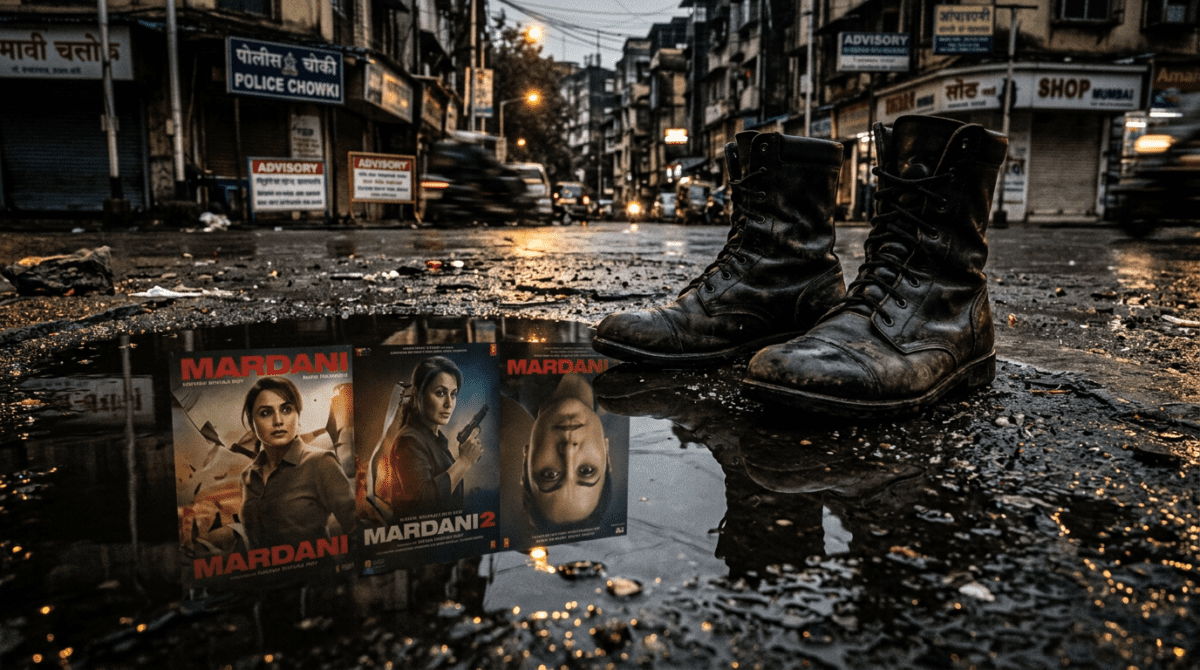
TL;DR: The Mardaani franchise evolved from a ₹35 crore first film in 2014 to a ₹66-67 crore third instalment in 2026. The Mardaani 3 vs Mardaani 1 comparison highlights a franchise that grew its audience through consistent quality, word-of-mouth loyalty, and Rani Mukerji’s commitment to the Shivani character. Each film improved on its predecessor.
The Mardaani franchise has done something quietly unusual in Bollywood. Over twelve years and three films, it built a consistent audience without ever being a mega-blockbuster. The Mardaani 3 vs Mardaani 1 comparison tells the story of a franchise that grew through trust rather than hype. And Rani Mukerji, at 48, proving she can still carry a franchise? That’s the story within the story.
The Beginning: Mardaani (2014)
When looking at the Mardaani 3 vs Mardaani 1 journey, When doing a deep Mardaani 3 vs Mardaani 1 analysis, we see the first film released in August 2014, and honestly, I don’t think anyone expected it to become a franchise. It was positioned as a one-off: Rani Mukerji playing a tough cop named Shivani Shivaji Roy who takes on a human trafficking ring.
The budget was modest—around ₹20-25 crore. The box office was decent but not spectacular: about ₹35 crore domestically. By Bollywood standards, that’s a hit given the budget, but it didn’t scream “sequel potential.” What it did do was connect with an underserved audience. Women who wanted to see a female-led action film and families who wanted a socially relevant thriller.
Mardaani 2 (2019): The Growth
Five years later, Mardaani 2 landed and something clicked, bridging the gap in the Mardaani 3 vs Mardaani 1 timeline.
The budget increased to about ₹35-40 crore. The villain (played by Vishal Jethwa) was genuinely chilling. The film tackled a different social issue while keeping the Shivani character at the centre. It collected roughly ₹50-55 crore domestically. A clear step up. More importantly, the audience composition shifted to include more families and younger viewers across Tier 2 and Tier 3 cities.
Mardaani 3 (2026): The Maturity
The ultimate Mardaani 3 vs Mardaani 1 comparison shows how much the scale has grown. Mardaani 3 arrived in February 2026 with a ₹60 crore budget. It’s currently sitting around ₹66-67 crore, making it a clean hit.
The third film is the most technically polished of the three. Better cinematography, tighter editing, and a script that gives Shivani more emotional depth. The social issue this time is different, but it follows the same successful formula: real problem, angry cop, confrontation, resolution.
Speaking of successful formulas and sequels, check out our deep dive into Bollywood Sequels in 2026 to see how the industry is betting big on franchises.

How the Numbers Compare
| Film | Year | Budget (₹ Cr) | Collection (₹ Cr) | ROI |
| Mardaani | 2014 | ~20-25 | ~35 | ~50-75% |
| Mardaani 2 | 2019 | ~35-40 | ~50-55 | ~40-50% |
| Mardaani 3 | 2026 | ~60 | ~66-67 | ~10-12% |
Looking closely at the Mardaani 3 vs Mardaani 1 box office numbers, the interesting trend is that while total collections grew, the ROI percentage actually decreased.Mardaani 1 was the most profitable relative to its budget. This is a common franchise pattern where budgets inflate faster than audiences grow.
How Shivani Shivaji Roy Evolved as a Character
A core part of the Mardaani 3 vs Mardaani 1 debate is how Shivani has changed.
Mardaani 1: Shivani is angry, relentless, and somewhat one-dimensional. She’s a force of nature.
Mardaani 2: Added vulnerability. There are moments where Shivani is scared, letting her be fallible without weakening her.
Mardaani 3: Goes further. Shivani is now dealing with the accumulated trauma of years of violent cases. She has trouble sleeping, and her personal relationships are strained.
Rani Mukerji ages into the role rather than fighting it. She’s 48, and the character reflects the fatigue, the wisdom, and the shorter fuse. It all feels earned.

What Other Franchises Can Learn From Mardaani
The Mardaani formula is worth studying because it’s not based on spectacle. It’s based on consistency.
Consistent character. Every film centres Shivani. You know what you’re getting.
Consistent quality. None of the three films are masterpieces, but none are bad either. All three deliver on their promise.
Consistent messaging. Each film tackles a real social issue. That gives the franchise purpose beyond entertainment, which deepens audience loyalty.
Consistent budgets (relatively). The budgets grew but never ballooned to the point where profitability became impossible.
Compare this to franchises like Dhoom, which went spectacle-heavy with each instalment and lost the character grounding. Or Housefull, which prioritised star casting over story consistency. Mardaani kept it simple, and simple worked.
For more on Bollywood’s sequel strategy across the industry, we’ve got a deep dive.
Will There Be a Mardaani 4?
Probably, but not soon.
Rani Mukerji has said in interviews that she’d do another one if the script justifies it. YRF clearly sees the franchise as viable. The audience is there. So all the conditions for a fourth film are met.
The gap between 2 and 3 was seven years. If a similar gap applies, Mardaani 4 would come around 2032-2033, when Rani would be in her mid-50s. And honestly? A Shivani Shivaji Roy in her 50s, dealing with a crime world that’s evolved beyond her methods, sounds like a compelling story.
But that’s speculation. For now, Mardaani 3 is a worthy addition to a franchise that’s quietly become one of Bollywood’s most reliable.
FAQs
How does the box office compare in Mardaani 3 vs Mardaani 1?
Mardaani 1 earned around ₹35 crore on a ₹20-25 crore budget, while Mardaani 3 grossed ₹66-67 crore on a ₹60 crore budget.
Are the stories connected in the Mardaani 3 vs Mardaani 1 timeline?
Loosely. Rani Mukerji plays the same character (Shivani Shivaji Roy), but each film has a standalone story with a different villain and social issue.
Who plays Shivani in Mardaani?
Rani Mukerji plays the lead role in all three films.
Will there be a Mardaani 4?
It is not confirmed, but Rani and YRF have both indicated interest if the right script comes along.
Which is the best Mardaani film?
Mardaani 3 is the most polished, but Mardaani 2 had the strongest villain. Personal preference plays a big role here.
Sources: Box office tracking data from Bollywood Hungama, Sacnilk, and various trade publications
Final Thoughts
The Mardaani 3 vs Mardaani 1 evolution from a mid-budget experiment to a genuine box office force is one of the better stories in modern Bollywood. Rani Mukerji built something that didn’t depend on spectacle or hype but on consistently strong storytelling.Whether there’s a Mardaani 4 or not, the massive growth seen in the Mardaani 3 vs Mardaani 1 journey has already proven its point: women-led action films work in India. The numbers don’t lie.