
Walk into a traditional big-box gym a few years ago, and the scene was almost entirely uniform: rows of individuals isolated by noise-canceling headphones, avoiding eye contact, and quietly grinding through their routines. Today, however, a massive cultural shift has completely transformed the wellness landscape as part of the community fitness evolution. Driven by a global epidemic of loneliness and a desire for authentic human interaction, millions of people are trading their solitary treadmill sessions foWhat is Driving the Shift to Group Workouts vs Solo Training?r the high-fives of functional fitness racing, the shared suffering of small group training, and the conversational pacing of weekend run clubs.
For those wondering why this dramatic shift is happening, the answer is grounded in both psychology and profound structural support. People overwhelmingly prefer group workouts vs solo training because communal environments provide built-in accountability, trigger the “motivation multiplier” effect, and offer a deep sense of social belonging that solitary exercise simply cannot replicate. This fundamental desire for connection has catalyzed the massive community fitness evolution, steering the industry away from the isolating aesthetics of pure bodybuilding and into a vibrant, highly social ecosystem defined by movements like CrossFit, HYROX and run clubs.
TL;DR: Quick Summary
- The Power of the Pack: Research shows that working out alongside others can increase how long someone exercises by up to 200%, thanks to the psychological “Kohler Effect” where individuals push harder to match the group’s energy during the community fitness evolution.

- The Dating App Exodus: A staggering 58% of people report making new friends via fitness groups, and nearly 1 in 5 Gen Zers have gone on a date with someone they met through exercise, effectively replacing bars and nightlife.
- The Rise of HYROX: Bridging the gap between traditional endurance running and high-skill CrossFit, HYROX and run clubs have rapidly democratized competitive fitness, leading to over 5,000 affiliated gyms worldwide.
- Holistic Health Shift: The modern fitness industry has expanded beyond physical aesthetics. The integration of mental wellness, recovery, and social connection in fitness is now a core consumer priority.
- Accountability Beats Motivation: Small group training thrives because it replaces fleeting internal motivation with powerful external accountability; your coach and peers actively notice and care when you show up as part of this community fitness evolution.


What is Driving the Shift to Group Workouts vs Solo Training?

To understand the core mechanics of the community fitness evolution, we must look at why traditional solo training so frequently fails. Most people who struggle to stay consistent with exercise are not inherently lazy; they simply suffer from a lack of structural support. Solo workouts feel manageable in theory, but when a long workday or bad weather hits, internal motivation evaporates. Because no one is waiting for you, it becomes incredibly easy to skip a session.
Group fitness entirely fixes this structural vulnerability. When you transition from solo routines to small group personal training or a local running club, you are introduced to behavioral entrainment. Your physical habits naturally sync with the rhythm of a collective. Furthermore, exercise psychology highlights a phenomenon known as the “Kohler Effect.” This principle dictates that individuals consistently outperform their solo efforts when they are part of a group, largely because no one wants to be the weakest link. A study published in the Journal of the American Osteopathic Association further solidified this, revealing that individuals who exercised in a group reported a 26% reduction in stress and a significantly higher quality of life compared to those who did the exact same workout alone, further fueling the community fitness evolution.
When Did the Community Fitness Evolution Begin?
The roots of this profound shift can be traced back to the early 2000s with the explosive rise of CrossFit. Before CrossFit, the gym floor was largely a collection of isolated bodybuilders and solitary cardio machines. CrossFit reintroduced the “tribe” mentality to the mainstream, combining constantly varied, high-intensity functional movements with an environment where everyone knew your name and cheered for the last person to finish the workout.
However, as the fitness industry matured into the post-pandemic era, consumer preferences evolved again. By 2024 and 2025, the market saw health club memberships swell to 77 million, with visits increasing by 8%. People began to crave the intense community aspect of CrossFit but often sought modalities with a lower barrier to entry. This distinct timeline birthed the current era of HYROX and run clubs. Emerging out of Europe and rapidly expanding globally by 2026, functional fitness racing stripped away the complex Olympic weightlifting of CrossFit and replaced it with universal movements like sled pushes and rowing. Simultaneously, casual neighborhood run clubs exploded in popularity as a low-cost, high-connection alternative to digital isolation, becoming a cornerstone of the community fitness evolution.
How HYROX and Run Clubs Redefined Social Connection in Fitness
The mechanics of how these two distinct ecosystems operate reveal exactly why the community fitness evolution is so wildly successful. HYROX and run clubs cater to the human need for shared goals.
HYROX operates on the principle of “Standardization as a Service”. Every race on Earth consists of the exact same format: a 1-km run followed by a functional workout station, repeated eight times. Because the workout never changes, athletes can compare their times on global leaderboards, gamifying fitness on a planetary scale. It acts as a massive “fitness festival,” providing a profound sense of shared suffering and belonging that an isolated gym session can never replicate.
On the opposite end of the intensity spectrum, but equally powerful, are modern run clubs. According to Strava’s 2024 Year In Sport report, modern fitness enthusiasts are intentionally trading intense, hours-long grinds for routines that prioritize social connection in fitness. The data revealed a 13% increase in large group activities, which notably featured three times more “downtime” than solo activities to explicitly make room for coffee breaks and catch-up chats. People are no longer running just to burn calories; they are running to belong, supporting the ongoing community fitness evolution.
Who is Fueling the Demand for Functional Fitness Racing?
The demographic driving the community fitness evolution is incredibly diverse, yet they all share a common desire for purpose-driven experiences.
Gen Z and Millennials are leading the charge, exercising more frequently and demanding holistic experiences that combine mental wellness, social interaction, and physical effort. Furthermore, the “Hybrid Athlete”—an individual who trains for both raw strength and cardiovascular endurance—has become the new standard in functional fitness racing.
Interestingly, this evolution has also captivated the corporate wellness sector. Companies are moving away from stale trust falls and instead enrolling their employees in HYROX Relay or Doubles divisions. This provides corporate teams with a tangible, health-focused goal to rally around, forging incredibly strong bonds through collective physical effort and a shared interest in the community fitness evolution.
Step-by-Step Guide: How to Transition from Solo Gym Goer to Group Athlete
If you have spent years grinding away by yourself and want to experience the incredible benefits of the community fitness evolution, follow these steps to integrate seamlessly:
- Identify Your Social Comfort Level: If you are highly competitive, a local CrossFit box or a HYROX-affiliated gym is your best starting point. If you prefer low-pressure, conversational interactions, search social media for a neighborhood run club.
- Embrace the 21-Day Rule: Commit to attending your chosen group consistently for three weeks. Small group training facilities often offer a “21-Day Kickstart” to help you build the habit before internal motivation wanes as you join the community fitness evolution.
- Focus on Form Through Small Group Coaching: Do not jump straight into massive 40-person boot camps where form is ignored. Find a small group of 4 to 8 people where a certified coach can offer personalized feedback and modifications without the exorbitant price tag of 1-on-1 private training.
- Sign Up for a Goal Event: The fastest way to build camaraderie is to train for a specific event together. Register for a local 5K, a Tough Mudder, or a HYROX Doubles race with a friend. Having a concrete date on the calendar transforms your routine from general exercise into purposeful training.
- Participate in the “Downtime”: The magic of group workouts vs solo training happens in the margins. Do not leave the moment the workout ends. Stay for the post-run coffee or the post-WOD fist bumps; this is where true social connection in fitness is forged.
Benefits & Features of the Community Fitness Ecosystem
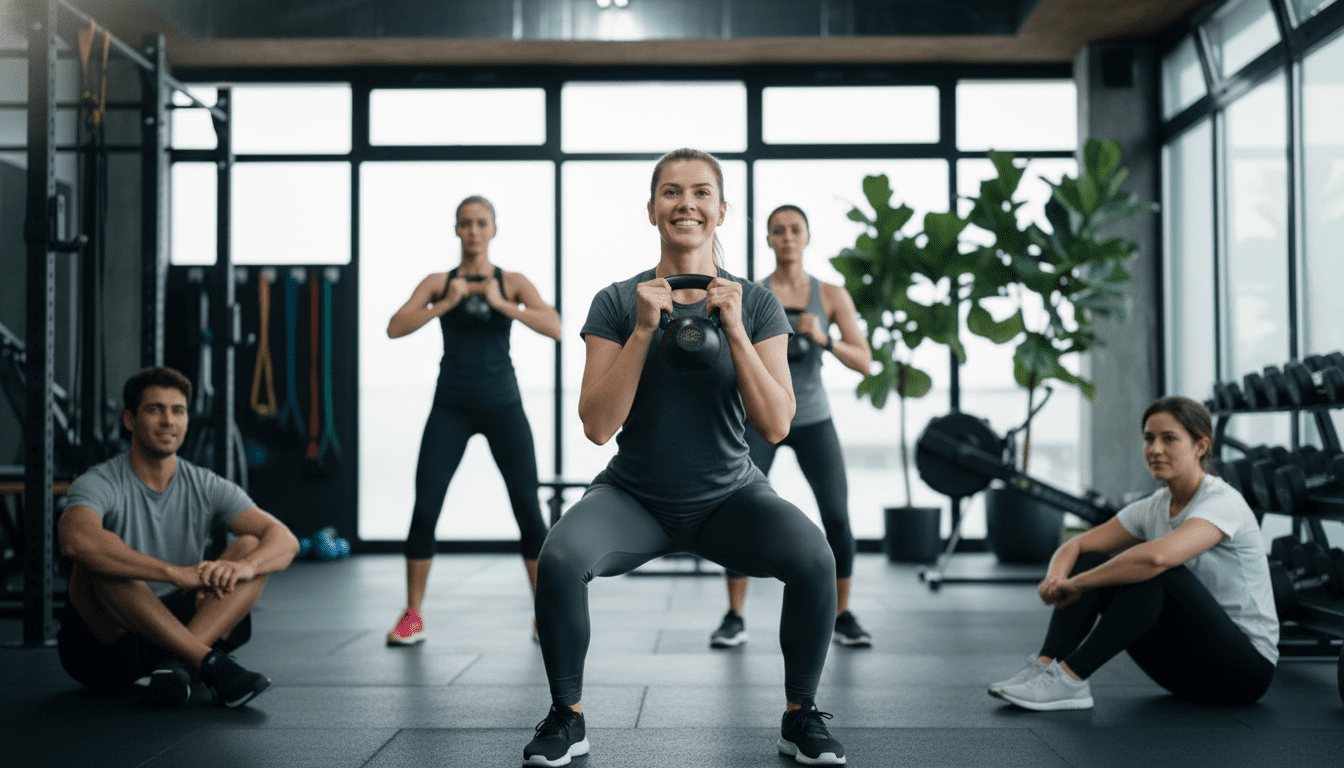
The advantages of ditching your solo routine for a collective environment extend into every facet of your physical and mental health within the community fitness evolution:
- Unmatched Accountability: In small group settings, your presence matters. If you skip, your coach and peers notice. This external social obligation is infinitely more reliable than internal motivation.
- Cost-Effective Expertise: Group fitness grants you access to professional programming, periodization, and expert form correction at a fraction of the cost of traditional private personal training.
- The Motivation Multiplier: The energy in a room is contagious. Thanks to social facilitation, you will naturally attempt heavier weights, run a bit faster, and hold planks longer simply because you are surrounded by others doing the same in the community fitness evolution.
- Holistic Mental Health: Group training combats the modern loneliness epidemic. The shared vulnerability of struggling through a difficult workout accelerates relationship building, providing an emotional support system that extends far beyond the gym doors.
Real-World Case Study: The CrossFit to HYROX Pipeline
To truly understand how these fitness communities intersect and evolve, one only needs to look at the relationship between CrossFit and HYROX. While some media outlets try to pit them against each other, they are highly complementary forces within the community fitness evolution.
CrossFit spent two decades building the methodology of mixed-modality training, forging incredibly fit athletes capable of handling high-power output and complex gymnastics. However, a veteran CrossFit gym owner noted that elite, complex fitness can sometimes be too niche to capture the absolute general public. Enter HYROX. By taking the intensity, competitive spirit, and community vibe of CrossFit, but utilizing highly accessible movements (like rowing, lunging, and farmer’s carries), functional fitness racing created a sport with zero technical barrier to entry and expanded the community fitness evolution.
This synergy is best illustrated by elite CrossFit Games champions like Tia-Clair Toomey-Orr and Justin Medeiros, who seamlessly transition into HYROX races and dominate, proving that the base built in a CrossFit affiliate perfectly translates to functional fitness racing. Consequently, thousands of gyms worldwide are now retrofitting their spaces to become hybrid “Performance Centers,” serving both the hardcore CrossFit athlete and the everyday HYROX competitor under one highly social roof as the community fitness evolution continues to grow.
“This year showed that people are taking control of their active lives and moving in a way that works for them. The rise of a more relaxed workout routine that’s rooted in social connection proves that working out is no longer about burning out.” — Zipporah Allen, Chief Business Officer at Strava.
“There’s something magical that happens when individual fitness goals merge with collective energy… community fitness transforms exercise from a solitary pursuit into a shared experience that elevates everyone involved.” — Austin Fit Magazine.
Data Table: Analyzing the Group Workouts vs Solo Training Landscape
| Fitness Format | Primary Demographic Focus | Technical Skill Barrier | Cost Accessibility | Social Connection Level |
|---|---|---|---|---|
| Traditional Solo Gym | Aesthetic / Bodybuilding | Low to Medium | High Accessibility (Low Cost) | Very Low (Isolated) |
| Run Clubs | Gen Z & Millennials / Dating | Very Low | Extremely High (Often Free) | Very High (Conversational) |
| Small Group Training | Beginners to Intermediates | Low (Coach Guided) | Moderate (Shared Cost) | High (Accountability) |
| CrossFit | High-Intensity / GPP Seekers | High (Olympic Lifts) | Moderate to Premium | Very High (Tribal Bond) |
| HYROX Racing | Hybrid Athletes / Corporate | Low (No complex lifts) | Premium (Event Fees) | High (Mass Spectacle) |
Unique Insight: The “Dating App Exodus”
Perhaps the most fascinating hidden trend within the community fitness evolution is how it is fundamentally rewriting modern romance. As remote work leaves millions isolated in their homes, the traditional avenues for meeting people have dried up. Simultaneously, younger generations are experiencing severe “dating app fatigue,” exhausted by the endless, impersonal swiping of Tinder and Hinge.
In response, Gen Z and Millennials have engineered a massive cultural pivot: the run club is the new nightclub. Strava’s massive data report revealed that nearly 1 in 5 Gen Zers have gone on a date with someone they met through exercise. They are four times more likely to prefer meeting someone during a workout than at a bar. In this new landscape of the community fitness evolution, sweat is the ultimate icebreaker. Shared physical exertion naturally strips away pretension, allowing people to bond over a mutual commitment to health and self-improvement rather than alcohol. It represents a profound shift where physical health and social connection in fitness/romantic health are no longer separate pursuits, but a unified lifestyle.
[Insert Video Placeholder Here]
FAQs
Why do people prefer group workouts vs solo training?
People overwhelmingly prefer group workouts because they provide an external structure of accountability. When peers and coaches expect you to show up, you are far less likely to skip. Additionally, the psychological “Kohler Effect” ensures that people naturally push themselves harder when surrounded by the energy of others.
What is HYROX and why is it so popular?
HYROX is a global fitness race that combines 8 kilometers of running with 8 functional workout stations (such as rowing, sled pushes, and wall balls). It is wildly popular because it offers the thrilling, competitive environment of an athletic event, but utilizes basic, safe movements that almost anyone can perform without prior technical training.
Is community fitness replacing traditional gyms?
While traditional gyms will always exist, the market is heavily shifting. Thousands of budget and commercial gyms are retrofitting their spaces with sled tracks and ski ergs to accommodate functional training, transitioning from mere “equipment rental spaces” into true “Performance Centers” focused on group preparation.
Can CrossFit athletes compete in HYROX?
Absolutely. CrossFit athletes naturally excel at HYROX because their training methodology builds immense work capacity across broad time domains. Elite CrossFitters like Tia-Clair Toomey-Orr frequently podium at HYROX events, proving the two sports highly complement one another.
Why are run clubs considered the new dating apps?
Younger generations, particularly Gen Z, are experiencing heavy dating app fatigue and drinking less alcohol. They are utilizing local run clubs as modern-day meetups to find like-minded, health-conscious partners in a low-pressure, highly social environment.
What is the “Kohler Effect” in fitness?
The Kohler Effect is a well-documented psychological phenomenon where individuals consistently perform better and push harder when working as part of a group, compared to when they work alone. It is driven by the subconscious desire to match the group’s effort and not be the weakest link.
Is small group personal training worth the cost?
Yes. Small group training (typically 4 to 8 people) provides the expert programming, safety modifications, and real-time form correction of a private personal trainer, but at a significantly reduced fraction of the cost, making elite coaching accessible and sustainable.
Conclusion & CTA
The era of isolating yourself with headphones and grinding away on a treadmill in absolute silence is rapidly fading. The community fitness evolution has proven that human beings are fundamentally wired for connection, and that our physical output is directly tied to the energy of the people sweating next to us. Whether it is the intense, life-changing methodology forged inside a CrossFit box, the electrifying global spectacle of a HYROX arena, or the simple, conversational joy of a Sunday morning run club, group workouts vs solo training is no longer a debate—it is the definitive future of global health.
Are you ready to stop relying purely on fleeting motivation and start relying on a community that has your back? It is time to step out of your comfort zone and into the collective energy of a group. Find a local run club, sign up for a 21-day small group training kickstart, or grab a partner and register for your first functional fitness racing event. Share this article with your favorite workout buddy, and let us know in the comments below which community fitness trend you are jumping into this year!