Last Updated: 22 July 2026, 02:00 PM IST | Fact Checked By: SpotlightersPost Editorial Team.
The portrayal of Lord Ram on screen has always carried a unique significance in Indian cinema, transcending standard entertainment to touch the deep rooted faith of millions.
For generations, portrayal of Lord Ram on screen has helped people’s values by turning ancient religious texts into visual stories everyone can share. Now, director Nitesh Tiwari is making a huge, two-part movie set 5,000 years ago. This upcoming film has made people across the country excited and interested again in how modern movies portray this sacred story.
Featured Snippet Block
TL;DR:People are very excited to see Ranbir Kapoor as Lord Ram, as it brings a huge change to Indian movies. Taking on a holy role made famous by the legendary Arun Govil as Lord Ram, Kapoor’s acting will be watched very closely by everyone.
Before the Ramayana movie trailer release, this guide explains the physical, spiritual, and historical changes in how this story is shown on screen.
The Sacred Lineage: Tracing Lord Ram’s Cinematic Journey from Silent Screens to Modern Epics
The historic journey of portraying Lord Ram on the Indian screen began at the very dawn of cinema. Dada Saheb Phalke’s landmark silent film Lanka Dahan (1917) laid the foundation for translating mythological narratives into visual spectacles. Since societal taboos prevented women from acting in movies at the time, actor Anna Salunke took on a pioneering dual role, playing both Lord Ram and Goddess Sita on screen. This early artistic milestone proved that sacred belief could be adapted to reflect evolving cultural landscapes.
This visual tradition assumed a crucial socio-political role during India’s freedom struggle. Directed by Vijay Bhatt, the landmark film Ram Rajya (1943) presented the story of Lord Ram as a powerful metaphor for ideal governance, justice, and post-colonial moral resilience. The film remains historically significant as the only movie Mahatma Gandhi ever watched, echoing his socio-political vision of “Ramrajya” for a free and egalitarian India.
Following independence, filmmakers utilized mythological cinema to foster emotional and national unity. Vijay Bhatt’s Sampoorna Ramayan (1961) and Babubhai Mistry’s Luv Kush (1967) successfully connected families with traditional values, sacrifice, and spiritual education through grand sets and music.
This journey has shown that the cinematic representation of ranbir kapoor as lord ram is a dynamic phenomenon that continuously mirrors the developing cultural and sociological landscape of India.
By 1992, the India and Japan animated collaboration Ramayana: The Legend of Prince Rama, directed by Ram Mohan, Koichi Sasaki, and Yugo Sako, brought the epic’s message of pure devotion and moral values to a global platform.
The Living Standard: Why Arun Govil as Lord Ram Remains an Unmatched Cultural Icon
Ramanand Sagar’s television masterpiece Ramayan (1987-88) telecast on Doordarshan completely redefined the cultural and devotional reach of the epic.
The visual standard set by the show was so powerful that it ceased to be viewed as mere television. Whenever the series aired, village audiences would take off their slippers in respect, place garlands on television sets, and light agarbatti and flowers before the screen, transforming a regular serial into an active space of collective worship.
The face of Arun Govil as Lord Ram became so deeply etched in the Indian consciousness that his image remains printed on devotional iconography sold across the country. Wherever Govil traveled, people folded their hands in reverence, called him “Prabhu,” and touched his feet. To protect the sanctity of this touchstone portrayal, Govil made a conscious decision to refrain from taking any acting roles during his subsequent career that could ruin Lord Ram’s name or degrade the role’s dignity. This is the legendary benchmark that the decision of choosing ranbir kapoor as lord ram must ultimately satisfy.
This television classic possessed a unique structural advantage that a modern film simply cannot match. Ramanand Sagar’s son, Moti Sagar, recently pointed out that the 1987 TV show spanned 78 episodes, with each running 30 to 40 minutes. This extended runtime allowed the creators to explore the epic’s narrative, moral, and philosophical details with unparalleled depth. A theatrical film, by comparison, must condense this sweeping, centuries old story into a brief three to four hour cinema experience, making direct comparisons between the two formats structurally unequal.
The Adipurush Effect: How the 2023 Cinematic Backlash Radicalised Mythological Audits
The landscape for mythological films shifted dramatically with the release of Om Raut’s Adipurush in 2023. Starring Prabhas, Kriti Sanon, and Saif Ali Khan, the mega-budget project faced severe public backlash and intense trolling over its poor visual effects, modernized dialogues, characterization, and subpar costume choices. Critics heavily criticized the film for went too far from the traditional Ramayan, failing to capture the spiritual essence and dignity of the characters.
This commercial and critical failure created the Adipurush effect, fundamentally radicalizing how audiences view religious epics. Modern viewers no longer watch mythological films with innocence, meaning that the movie of ranbir kapoor as lord ram was instantly subjected to extreme, non-neutral scrutiny.
Instead, they act like strict auditors, critically inspecting dialogue registers, frame compositions, visual textures, and moral tone. In this new era, balancing artistic freedom with devotional expectations has become a highly challenging task for directors.
Because Adipurush represents a creative “rock-bottom,” Nitesh Tiwari’s Ramayana is bound to look vastly superior in terms of star cast, performances, and visual effects. However, the association of a mega-budget mythological film with the legacy of 2023 is highly damaging to the film’s PR. Fans remain highly defensive, creating a “once bitten, twice shy” environment where ₹4,000 crore budget results must be visible on the screen. There is absolutely no margin for error, and the filmmakers must ensure that the spirit of pure devotion is maintained alongside modern technical presentation.
Overcoming Hesitation: Inside Ranbir Kapoor’s Physical and Spiritual Reset
When producer Namit Malhotra first offered the lead role about four years ago, the initial reaction to the casting of Ranbir Kapoor as Lord Ram was an instant “No”. Ranbir Kapoor admitted he was initially scared from the responsibility, feeling he was not fit enough, not good enough, and would be unable to do full, honest justice to a figure revered by billions of people.
His perspective underwent a complete transformation with the birth of his daughter, Raha, in November 2022, following his marriage to Alia Bhatt in April 2022. He realized he was in a period of his life where he needed to change his lifestyle, and he saw the sweet coincidence of the choice of Ranbir Kapoor as Lord Ram and becoming a father as the perfect catalyst. His initial fear transformed into deep gratitude, prompting a complete physical, mental, and spiritual overhaul.
Kapoor underwent a drastic physical transformation to prepare for the role. To transition from his bulked-up, 12 kg brawny physique in Animal and prepare for the role of Ranbir Kapoor as Lord Ram, Kapoor worked closely with athletic trainer Nam Wook Kang.
Ditching heavy gym weights, Kapoor’s routine under Nam Wook kang focused on agility, lean core strength, and poise, using stability balls, kettlebells, and battle ropes to build an athletic warrior posture. For cardiovascular conditioning, Kapoor swapped the indoor treadmill for outdoor trail running, which helped him cultivate the mental clarity needed for the film’s deep emotional sequences.
The decision to cast Ranbir Kapoor as Lord Ram also carries a huge creative challenge: he is reportedly taking on a dual role in Nitesh Tiwari’s cinematic universe, playing both Lord Ram and Lord Parshurama. To prepare, Kapoor spent months studying the distinct spirituality, body language, and emotional motives of both characters. His preparation is built on a deep emotional and spiritual overhaul, which began the day he rewatched Ramanand Sagar’s television series to capture the absolute truthfulness, love, and respect required for the part.
A Poetic Torch-Passing: Generational Unity at the Pratham Sankalp Launch Event
The historic connection between the 1987 television icon and the 2026 IMAX cinematic event was officially celebrated at the grand Pratham Sankalp showcase. Held at Bharat Mandapam in New Delhi on Saturday, 18 July 2026, the event brought together the film’s cast and crew to launch the movie’s global promotional campaign. This landmark event officially marked the beginning of a new era in mythological storytelling.
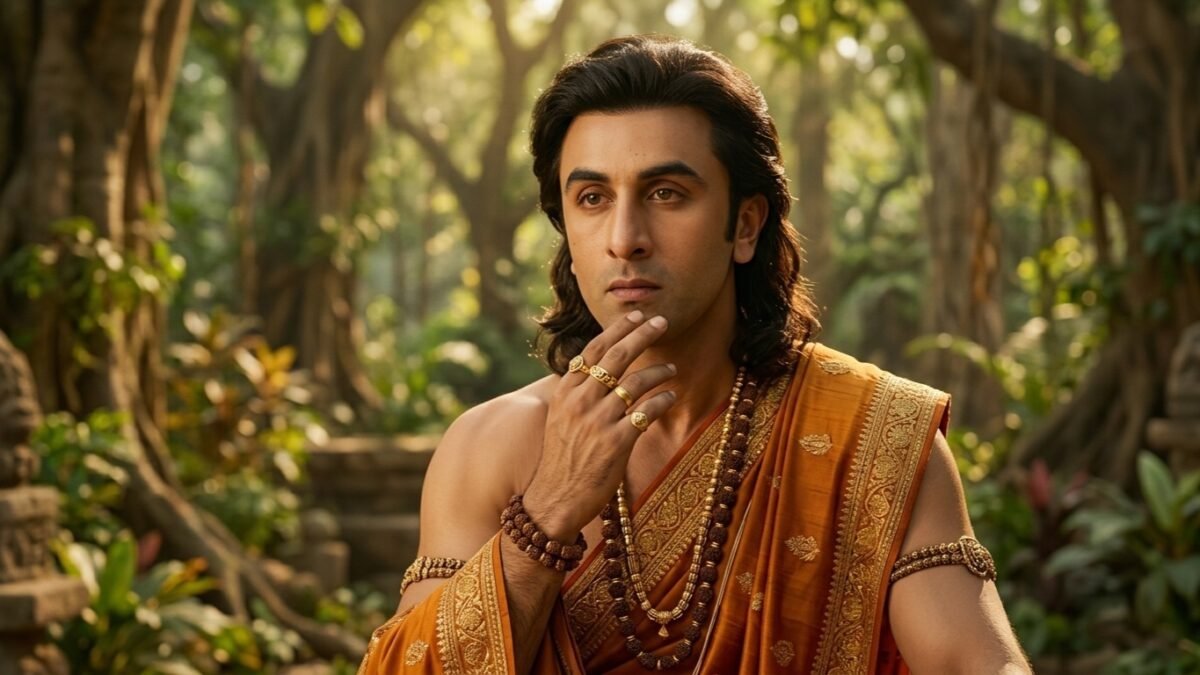
During an event, the actor paid a heartfelt tribute to Govil, validating that the casting of ranbir kapoor as lord ram was deeply rooted in reverence for the 1987 legacy. Kapoor stated, “If I can achieve even a fraction of how you allowed Lord Shri Ram to become a part of you, I will feel that all my hard work has borne fruit”.
Govil warmly returned the praise and officially endorsed the choice of Ranbir Kapoor as Lord Ram. He stated that the upcoming film looks very good and that Ranbir looks very good as Lord Ram, describing him as a highly talented actor and a fine human being. Govil added that successfully playing a God on screen requires a good, pure soul, a quality he firmly believes Kapoor possesses. This poetic transition of roles has provided the project with immense credibility ahead of the highly anticipated Ramayana movie trailer release.
Confronting the Critics: Unseeing the Violence and Navigating Digital Skepticism
Despite official endorsements, the casting of Ranbir Kapoor as Lord Ram has met with vocal skepticism on digital platforms like Reddit. Many commentators highlight a perceived mismatch between Kapoor’s real life controversies such as his past statements about eating beef and a viral video of him pouring wine on a cake and the moral perfection of Maryada Purushottam.
Audiences on digital forums also find it difficult to “unsee” Kapoor’s highly violent and toxic action hero persona from his previous film Animal. Digital critics have targeted his aesthetic appearance in the teaser, criticizing his wigs as “ghastly,” his vocal delivery as a “smoker’s voice,” and suggesting actors like Mohit Raina, Saurabh Raj Jain, or Mahesh Babu as more aesthetically suited. Conversely, some fans defend the casting, arguing that viewers should treat the film purely as a movie made for entertainment rather than taking the casting decisions personally.
To combat this skepticism, the producers are executing a meticulous creative reset. By focusing on returning the epic to its grounded narrative believability, emotional depth, and realistic tension, they aim to build a cinematic experience that honors the traditional roots of the story while leveraging top-tier visual effects backed by DNEG and Prime Focus. For a deeper understanding of how the visual scale is being constructed, you can read about how Yash’s outfits for Ravana are being made with real gold.
Unified Lord Ram Portrayal Comparison Index
To help readers track how the depiction of Lord Ram has evolved over the decades, the following directory deconstructs the key narrative and production dimensions of major on-screen portrayals.
Table 1: Comparative Breakdown of Major On-Screen Portrayals of Lord Ram
| Comparative Dimension | Arun Govil (Ramayan, 1987) | Prabhas (Adipurush, 2023) | Ranbir Kapoor (Ramayana, 2026) |
|---|---|---|---|
| Media Format | 78-episode television series | Standalone theatrical feature | Two-part cinematic IMAX saga |
| Physical Philosophy | Traditional, stoic simplicity | Bulked-up, highly stylized action | Agility and lean core strength |
| Visual/VFX Integration | Minimalist set design & practical simplicity | High-end CGI (widely criticized as shoddy) | Top-tier visual effects (backed by DNEG & Prime Focus) |
| Character Dimensions | Explored singular, pure divinity | Focused heavily on superheroic action | Emotional, spiritual, and truthful depth |
| Production Context | Iconic television Doordarshan era | Met with intense public backlash | High-stakes, highly audited “faith test” |
| Official Source | Ramanand Sagar Productions | T-Series / Retrophiles | Prime Focus / Monster Mind [Rediff.com] |
Most Asked Questions (FAQs)
What makes the casting of ranbir kapoor as lord ram unique compared to past portrayals?
Picking ranbir kapoor as lord ram is special because it’s for a huge, high-tech IMAX movie with a ₹4,000 crore budget. Seeing this ancient story on massive screens is a big change from the older TV shows.
How did Arun Govil react to the casting of ranbir kapoor as lord ram?
Arun Govil, who played Ram in the 1987 series, praises the film and supports ranbir kapoor as lord ram. He believes Kapoor’s talent and pure soul make him perfect to play a God.
Who does Arun Govil play in Nitesh Tiwari’s upcoming Ramayana film?
In a deeply symbolic casting choice that bridges different generations, veteran actor Arun Govil is playing King Dasharath, Lord Ram’s father, in Nitesh Tiwari’s film. This marks a poetic transition for Govil, who moved from portraying the divine prince in the 1987 television classic to playing his royal father in the upcoming 2026 adaptation.
Why are audiences comparing Nitesh Tiwari’s Ramayana to the 2023 film Adipurush?
Arun Govil, who famously played Lord Ram in the 1987 TV series, is returning in the new 2026 film to play Ram’s father, King Dasharath.
What is the “Pratham Sankalp” event hosted for Nitesh Tiwari’s Ramayana?
On July 18, 2026, the movie’s global campaign launched with The Ramayana: Pratham Sankalp event at Bharat Mandapam, New Delhi. Gathering the cast and crew, it highlighted Ranbir Kapoor’s emotional tribute speech to veteran actor Arun Govil.
Why did the actor chosen for the casting of ranbir kapoor as lord ram initially reject the role?
When producer Namit Malhotra offered the role four years ago, the immediate reaction to the casting of ranbir kapoor as lord ram was an outright rejection. Kapoor was scared of the responsibility, feeling unfit and not good enough to do justice to a character revered by billions.
How did Raha change his mind regarding the decision to cast ranbir kapoor as lord ram?
Ranbir Kapoor explained that becoming a father to Raha (born November 2022 to Alia Bhatt) coincided with the film offer when he needed a lifestyle change. This turning point shifted his fear into gratitude, securing the choice of ranbir kapoor as lord ram.
What are the main public criticisms surrounding the casting of ranbir kapoor as lord ram?
Reddit critics argue the casting of ranbir kapoor as lord ram clashes with the calm “maryada purushottam” image due to his violent role in Animal and real-life controversies (eating beef, pouring wine). Additionally, they criticize his teaser for “ghastly” wigs, a “smoker’s voice,” and lacking a divine aura.
When is Nitesh Tiwari’s Ramayana scheduled to release in theatres?
Nitesh Tiwari’s Ramayana is designed as a two part live action saga filmed for IMAX, with Part One officially scheduled to release worldwide during Diwali 2026, and Part Two set to follow in theatres during Diwali 2027.
When will the first official trailer for the 2026 Ramayana be released?
While a first 3 minute visual glimpse was unveiled globally on July 3, 2025, the filmmakers have officially confirmed that the first full length global theatrical trailer for Nitesh Tiwari’s Ramayana will premiere worldwide on Friday, 24 July 2026.
Also Read:
- Ramayana Part 1: Everything We Know About Ranbir Kapoor’s Epic Trilogy and the 2026 ReleaseHow Prakash Jha’s Raajneeti Transformed Ranbir Kapoor’s Dramatic Career
- Karan Johar Secures Ramayana Movie Hindi Distribution Rights for Record ₹350 Crore
- Ramayana: Nitesh Tiwari’s Rs 4,000 Crore Saga Maps Local-to-Global Cinematic Roadmap
- Embodying Divinity: Sai Pallavi’s Spiritual Method for Sita, Ranbir Kapoor’s Lifestyle Overhaul, and the ₹4,000 Crore Ramayana Launch
- The Dawn of an Epic: Inside the Unprecedented Ramayana Trailer Reaction, Yash’s Lethal Ravana, and Rishab’s Electronic Sitar
Disclaimer: All images, posters, character designs, and trailers referenced in this article are the intellectual property of Bennett, Coleman & Co. Ltd. / Ramanand Sagar Productions / Prime Focus Studios / Yash Raj Films / Daath Voyage / The Financial Express and their respective creators. They are utilized here under fair use guidelines for journalistic reporting and sports/entertainment commentary.