

TL;DR: Streaming platforms now account for a massive chunk of industry revenue. In the new Bollywood streaming business model, OTT rights deals often cover 30-50% of a film’s budget before release. This is changing what films get made, how they are marketed, and who holds the power in the industry. Theatres aren’t dead, but they’re no longer the only game.
The Bollywood streaming business model conversation has shifted from “will OTT change things” to “how fast is OTT changing things.” And the answer, from what I’ve seen in 2026, is pretty fast. The economics of how Hindi films get financed, distributed, and monetised are fundamentally different from even five years ago. Here’s what’s actually happening.
How Did Bollywood Make Money Before Streaming?
Before the Bollywood streaming business model took over, the industry’s revenue was basically four buckets:
Theatrical revenue: Box office collections determined everything. This accounted for roughly 50-60% of total earnings.
Satellite TV rights: Channels like Sony MAX and Zee Cinema paid upfront for broadcast rights.
Music rights: T-Series or Saregama paid for audio distribution.
Overseas distribution: The UK, US, Gulf, and Australian markets provided strong returns for star-driven films.
That model still exists, but the Bollywood streaming business model has inserted itself as a fifth bucket that’s rapidly growing and reshaping the other four.
What’s the New Revenue Split?
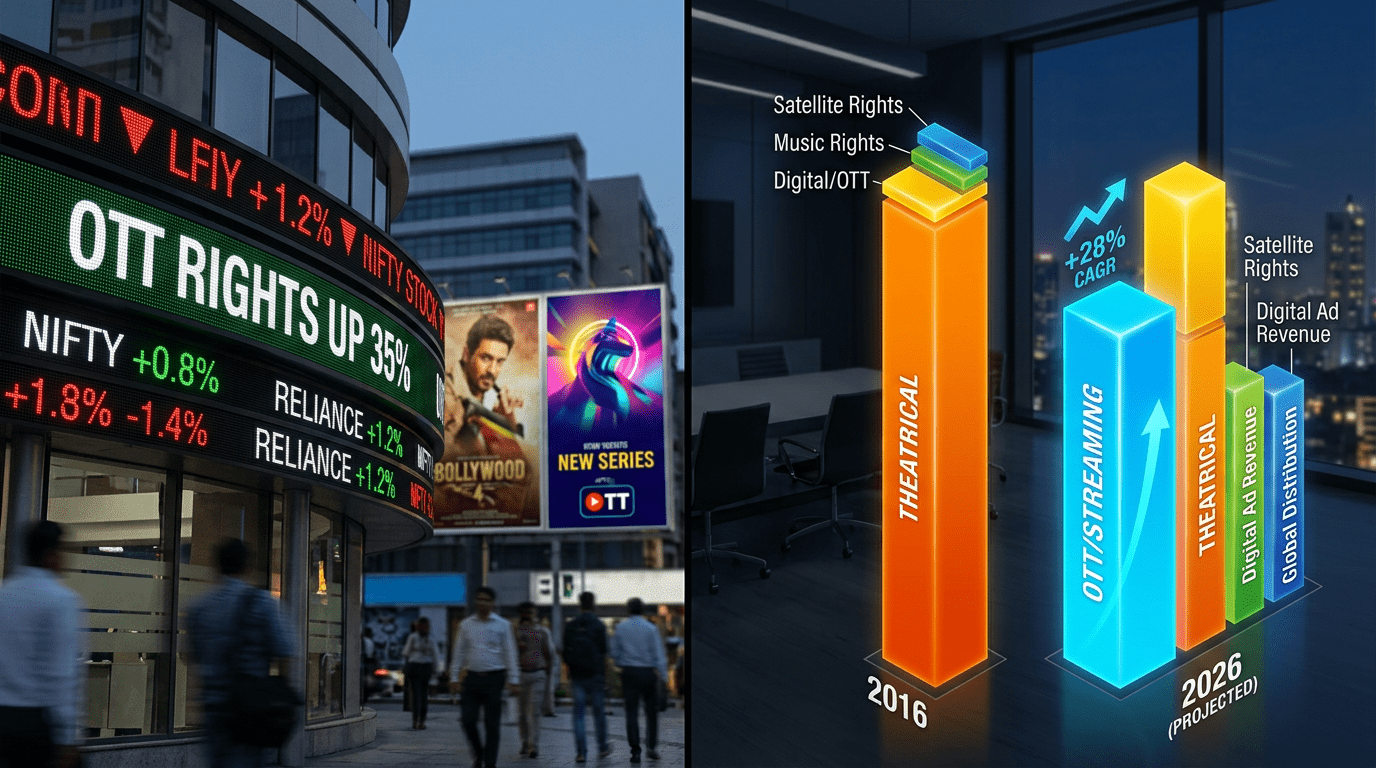
In 2026, a typical mid-to-big Hindi film’s revenue looks roughly like this under the modern Bollywood streaming business model:
| Revenue Stream | Approximate Share | Trend |
| Theatrical | 35-45% | Declining slightly |
| OTT/Streaming rights | 25-35% | Growing fast |
| Satellite TV | 10-15% | Stable to declining |
| Music rights | 5-10% | Stable |
| Overseas | 5-10% | Stable |
The big shift is OTT going from basically zero percent a decade ago to 25-35% today. For some mid-budget films, the OTT deal alone covers the production budget. That changes the risk calculation entirely.
How OTT Deals Work in Bollywood
Here’s how it typically goes. A production house is developing a film. Before they start shooting, they approach Netflix, Amazon, JioHotstar, and ZEE5 with the package.
The OTT platform evaluates the package and makes an offer for streaming rights. This offer is usually a flat fee, paid in instalments. For a film budgeted at ₹50 crore, the OTT deal might be ₹15-25 crore depending on the cast. That money arrives before the film even releases, which is the biggest advantage of the Bollywood streaming business model. It’s guaranteed revenue.
The flip side? The OTT platform now has leverage. They can negotiate the Bollywood OTT Theatrical Window, exclusive rights periods, and even creative input.
What Films Get Made Because of Streaming?
This is maybe the most important question regarding the Bollywood streaming business model, and it cuts both ways.
Films that would never have been made: Projects like indie thrillers exist because OTT funded them. Theatres wouldn’t have given these films enough screens, but on OTT, they found massive audiences. (AI tools are also helping lower costs for these indie filmmakers. Read more in our AI Technology Bollywood breakdown).
Films designed by algorithm: Streaming platforms use data to decide what gets greenlit. If “romantic thriller” is a high-performing category, you’ll get ten shows in that mould. The data-driven approach can push toward formula over originality.
Are Theatres in Trouble?
They’re not dying, but they’re adapting to the Bollywood streaming business model. Multiplex chains are leaning hard into the “experience” angle (IMAX, 4DX). If you can watch a film at home, the theatre needs to offer something streaming can’t.
Big spectacles still pull crowds. However, mid-budget dramas are increasingly OTT-first under this new Bollywood streaming business model.
The Netflix and Amazon Strategy in India
Both platforms are playing slightly different games.
Netflix India is going premium. Fewer titles, higher budgets, more polished production. Their strategy is to be the HBO of Indian streaming: quality over quantity. Shows like Kohrra and films like Accused fit this mould.
Amazon (through Prime and MX Player) is going wide. More titles across more price points and formats. MX Player gives them the free, ad-supported tier. Prime gives them the premium subscriber base. They’re covering both ends of the market.
JioHotstar has the cricket advantage. Their subscriber numbers spike during IPL and international cricket seasons, and they use that audience to cross-promote entertainment content. It’s a strategy nobody else can replicate because nobody else has cricket rights.
All three are investing heavily in Hindi original content. And all three are paying producers enough that the OTT deal has become a critical part of every film’s financial planning.
For more on franchise strategies in this new landscape, we’ve covered how sequels and returning IP fit the streaming model.

What’s Next for Bollywood’s Business Model?
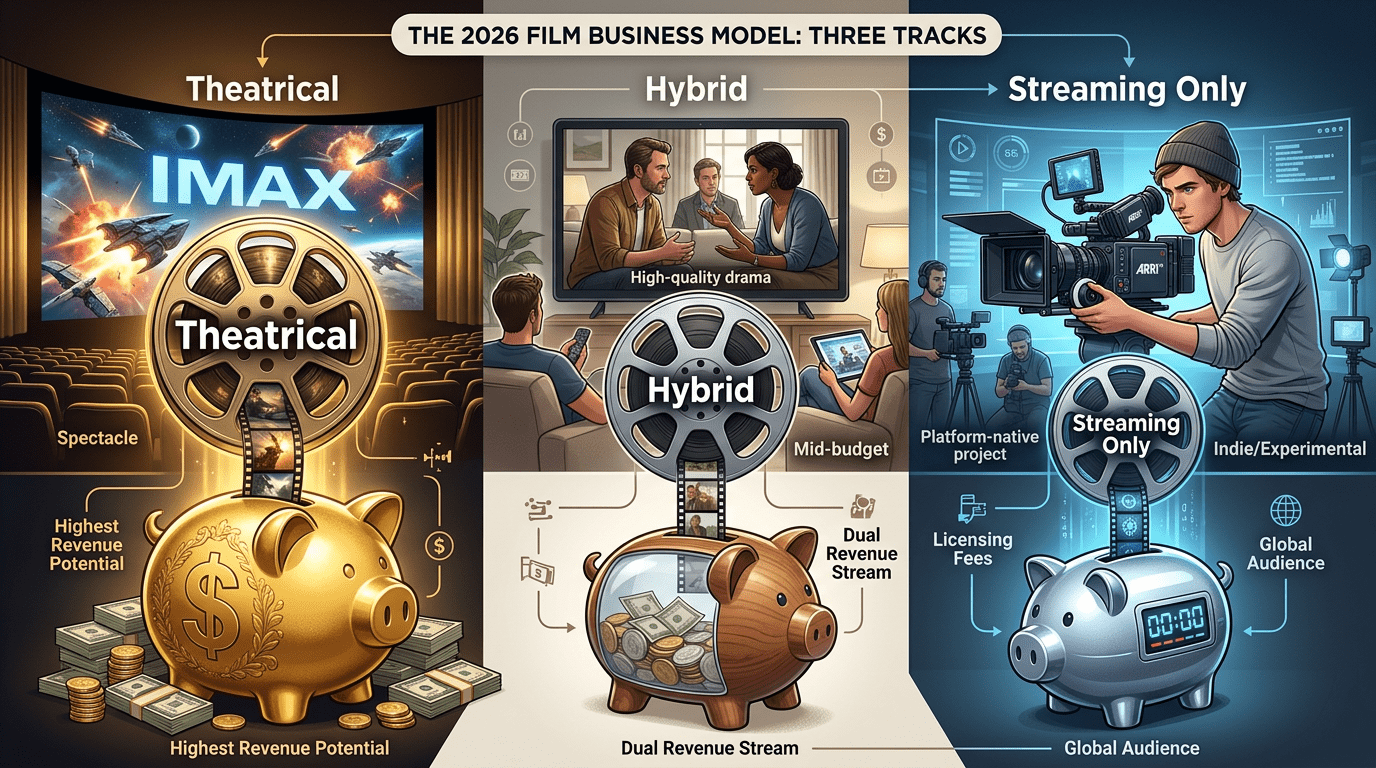
I think we’re heading toward a world where “Bollywood” isn’t one business model but three.
Big-budget spectacles will remain theatrical-first. These are the ₹200+ crore films designed for opening weekends and communal viewing. Their economics depend on the big screen.
Mid-budget content will increasingly be OTT-first or have very short theatrical windows. The audience for these films is already comfortable watching at home.
Low-budget and indie content will be almost entirely streaming-native. Platform-funded, platform-distributed, platform-measured.
That’s not a bad future. It’s more diverse than what we had before. But it does mean the old definition of “success” in Bollywood, meaning box office collection, becomes less relevant for a growing portion of Indian cinema.
FAQs
How much do platforms pay in the Bollywood streaming business model?
It varies widely. Major films with big stars can fetch ₹50-100+ crore for streaming rights, while mid-budget films typically get ₹10-30 crore.
Are theatres losing money because of the Bollywood streaming business model?
Some are, particularly single screens. Multiplexes are adapting with premium formats and experiences.
Which OTT platform is biggest in India?
JioHotstar currently has the largest subscriber base (partly due to live cricket rights), followed closely by Amazon Prime and Netflix.
Will theatres disappear entirely?
No. Big spectacle films still need theatres to recover massive budgets. But the types of films that exclusively depend on theatrical revenue are narrowing.
Is Bollywood making more money overall in 2026?
Total industry revenue (theatrical + streaming + satellite + music) is growing. But the distribution of that revenue is shifting significantly toward streaming.
Sources: Industry reports, platform press releases, and trade analysis from Bollywood Hungama.
Final Thoughts
I think we’re heading toward a world where “Bollywood” isn’t one business model but three. Big-budget spectacles will remain theatrical-first. Mid-budget content will increasingly be OTT-first. Low-budget and indie content will be entirely streaming-native.
The Bollywood streaming business model hasn’t killed the old system; it’s built a new one alongside it. The power dynamics have shifted, the revenue splits have changed, and the definition of “success” is broader than it’s ever been.