Ask anyone from the National Capital Region who loves the mountains, and they will describe the same grueling weekend ritual. You would set your alarm for the crack of dawn, pack the car, and slowly crawl your way through Ghaziabad, Meerut, Muzaffarnagar, and Roorkee. Arriving in the Himalayan foothills was often a cocktail of exhaustion and regret, with the 280-odd kilometre journey swallowing eight to ten hours on bad traffic days. The idea of a spontaneous getaway was logistically possible, but emotionally punishing. This delhi-dehradun expressway guided tour explains how that journey has been revolutionized.
That calculus has permanently changed. The newly opened Delhi-Dehradun Expressway officially cuts the Delhi to Dehradun travel time from over six hours to approximately 2.5 hours over a streamlined 210-kilometer stretch. By completely banning slow-moving vehicles and introducing an advanced wildlife elevated corridor to protect the local ecosystem, this access-controlled highway allows travelers to reach their destinations safely and faster than ever before. This delhi-dehradun expressway guided tour is essential for anyone planning a trip north.
TL;DR: Quick Summary of the Delhi-Dehradun Expressway Guided Tour
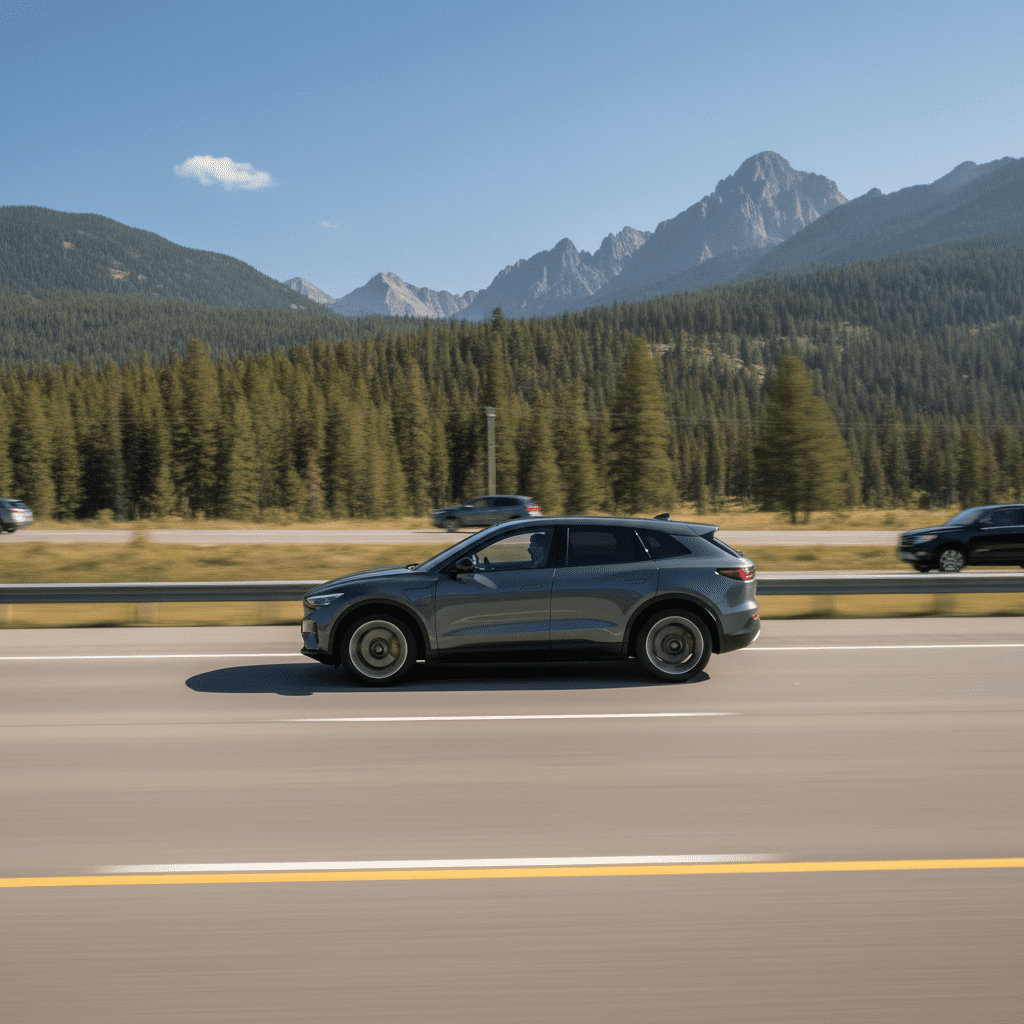
- Transformative Speeds: The 210 km corridor slashes the Delhi to Dehradun travel time to roughly 2.5 hours, operating with a maximum speed limit of 100 km/h for cars as detailed in this delhi-dehradun expressway guided tour.

- Ecological Engineering: The route features a groundbreaking 12 km wildlife elevated corridor and a 340-metre Daat Kali tunnel, actively protecting the Rajaji Tiger Reserve.
- Strict Vehicle Bans: For safety, two-wheelers, auto-rickshaws, and tractors are strictly prohibited on the Delhi-Dehradun Expressway, with violators facing fines up to ₹20,000.
- Toll Infrastructure: The highway uses a closed toll system. FASTag toll rates for a car traveling from Akshardham to the Saharanpur Bypass total ₹430.
- Real Estate Boom: Property prices in micro-markets along the corridor, including Dehradun and Saharanpur, are projected to appreciate by 15% to 25% according to this delhi-dehradun expressway guided tour.
What is the Delhi-Dehradun Expressway?
The Delhi-Dehradun Expressway, officially classified as the Delhi-Saharanpur-Dehradun Economic Corridor, is an engineering marvel built at a cost of approximately ₹11,868 crore to ₹12,000 crore. Engineered by the National Highways Authority of India (NHAI) under the Engineering, Procurement and Construction (EPC) mode, it is designed to handle high-speed cruising while entirely bypassing the notorious bottlenecks of NH-58 and NH-334. This delhi-dehradun expressway guided tour showcases the scale of this project.
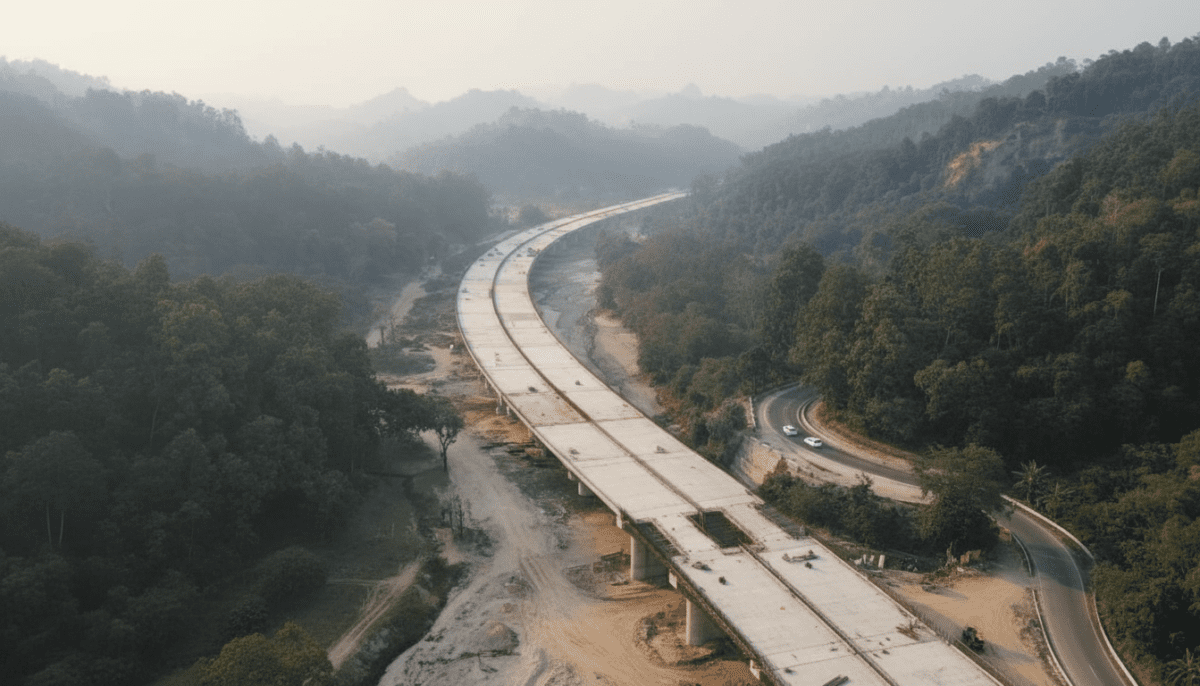
As part of this delhi-dehradun expressway guided tour, we see the mega-project is strategically divided into four distinct sections. Section 1 focuses on decongesting northeast Delhi, starting from the Akshardham Temple and featuring heavily elevated roadways through Geeta Colony and Mandola. Section 2 is a fully access-controlled, six-lane greenfield stretch passing through the districts of Baghpat, Shamli, and Saharanpur. Section 3 connects the Saharanpur bypass to Ganeshpur. Finally, Section 4 is the most environmentally sensitive stretch, weaving through the Reserve Forests of Uttar Pradesh and Uttarakhand.
When Did the Ecological Integration of the Delhi-Dehradun Expressway Occur?
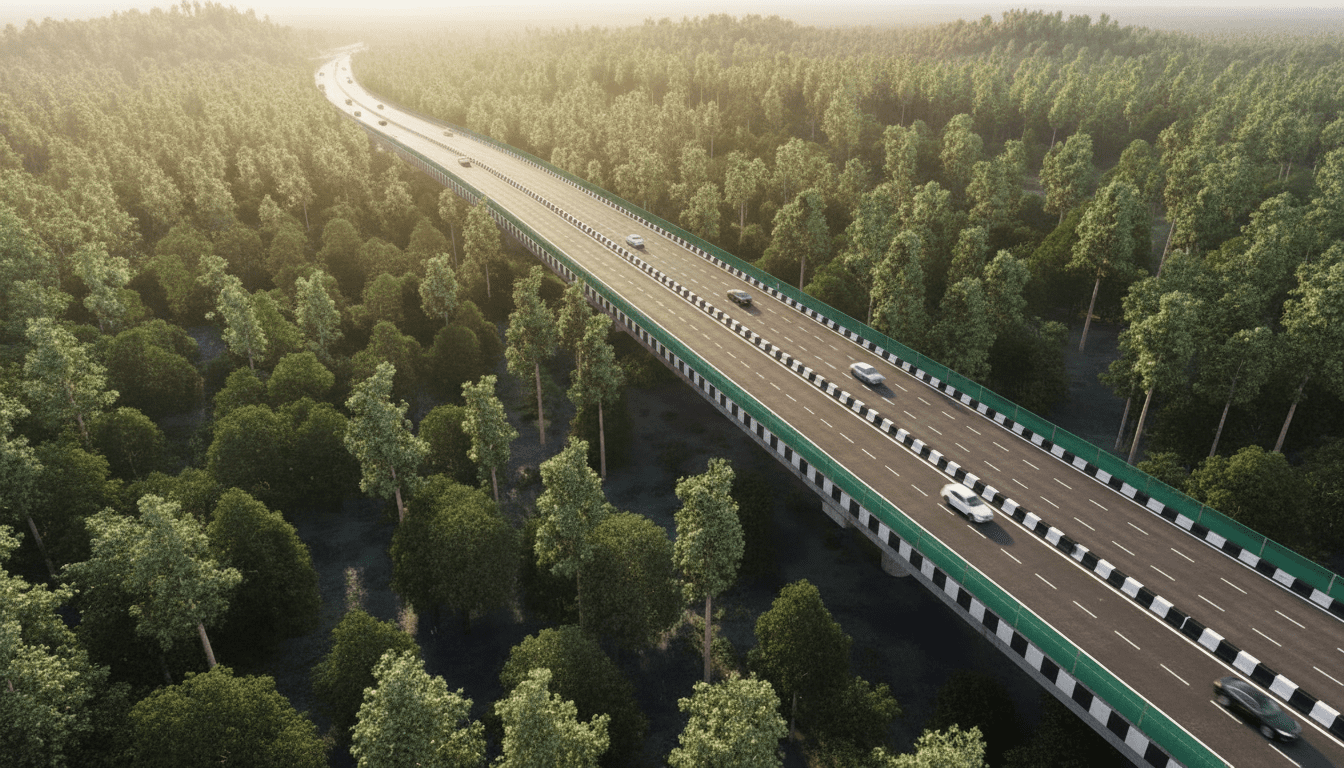
Infrastructure projects and environmental conservation have historically been at odds, but the final 20-kilometre stretch of the Delhi-Dehradun Expressway rewrites that narrative. Passing directly through the Shivalik Forest Division and the Rajaji Tiger Reserve, NHAI constructed Asia’s largest wildlife elevated corridor, stretching nearly 12 kilometres, a key highlight of our delhi-dehradun expressway guided tour.
Built at an average height of six to seven metres, vehicles speed above the forest canopy while wildlife moves completely undisturbed below. A recent 40-day monitoring study conducted by the NHAI and the Wildlife Institute of India (WII) deployed 150 high-tech camera traps and 29 AudioMoth acoustic recorders along this corridor. The study documented 40,444 images of 18 unique wild species utilizing the underpasses. From the Golden Jackal, Sambar, and Spotted Deer to an incredible 60 distinct instances of wild elephants safely navigating the corridors, the structure actively prevents human-wildlife conflict. Furthermore, authorities planted 1,95,000 trees across 165.5 hectares in both states to compensate for the diverted forest land. This delhi-dehradun expressway guided tour emphasizes the importance of these ecological protections.
How Does the Delhi-Dehradun Expressway Transform the Mussoorie Rishikesh Trip?
The psychological shift brought by this infrastructure is just as massive as the physical one. When the hills were seven hours away, you committed an entire weekend to the road, often rushing to cram activities into a 36-hour window. With the delhi-dehradun expressway guided tour insights, a Mussoorie Rishikesh trip occupies a completely different mental category, feeling closer to a quick day trip.
If you depart Delhi on a Friday night, you can comfortably arrive in Mussoorie by midnight. For adrenaline seekers heading to the adventure capital, a Saturday dawn departure puts you on the riverbanks of Rishikesh by 9 AM, leaving the entire day open for white-water rafting. Even Haridwar has transitioned into a legitimate same-day excursion, taking roughly two hours from the capital. The highway transforms these destinations from rigidly planned vacations into spontaneous weekend decisions, as noted in this delhi-dehradun expressway guided tour.
Who Cannot Use the Delhi-Dehradun Expressway?
High-speed corridors require strict safety protocols, and this delhi-dehradun expressway guided tour must highlight restrictions. NHAI officials have made it explicitly clear that the Delhi-Dehradun Expressway is not open to all traffic. To prevent fatal collisions caused by massive speed differentials, all slow-moving vehicles are banned.
This prohibition includes motorcycles, scooters, auto-rickshaws, tractors, and non-motorized transport. The maximum speed limit is firmly set at 100 km/h for cars and 80 km/h for heavy vehicles. Advanced speed cameras monitor the route, and any commuter caught bringing a banned vehicle onto the access-controlled lanes faces a hefty ₹20,000 fine under the Motor Vehicles Act, along with the potential confiscation of their vehicle. Two-wheeler riders must continue utilizing the older Delhi-Saharanpur highway as an alternative route, a necessary detail in any delhi-dehradun expressway guided tour.
Step-by-Step Guide: Navigating the Delhi-Dehradun Expressway Guided Tour
Driving a brand-new highway requires preparation. Based on recent commuter experiences and highway updates provided in this delhi-dehradun expressway guided tour, here is how to execute a flawless road trip:
- Pre-Load Your FASTag: The corridor utilizes a closed tolling system where you only pay for the exact distance traveled. All toll plazas are strictly FASTag-enabled; ensure your account is topped up to breeze through without delays while checking the latest FASTag toll rates.
- Fuel Up Early: As the infrastructure is still maturing, major amenities like petrol pumps and CNG stations are remarkably scarce on the main greenfield stretch. Currently, your best bet is to refuel before hitting the tunnel section, as the next reliable stations (including CNG priced around ₹82.50) appear closer to the Dehradun exit, as recommended in this delhi-dehradun expressway guided tour.
- Use Active Navigation: Early drivers have reported that signage can be confusing at night, particularly after exiting the Daat Kali temple tunnel. Keep your GPS active to avoid taking wrong turns toward towns like Paonta Sahib, which can add hours to your journey.
- Time Your Return: The Delhi-Dehradun Expressway handles outbound traffic flawlessly, but Sunday evening return journeys often bottleneck near the Akshardham and NH-58 entry points. To preserve your sanity, aim to leave Rishikesh or Dehradun by 2 PM on Sunday, as advised in this delhi-dehradun expressway guided tour.
- Beware of Road Works: Keep an eye out for sudden lane closures. Maintenance crews occasionally place drums or barriers for minor finishing works, which can be hazardous if you are overtaking at 100 km/h, especially after sunset.
Benefits & Features of the Delhi-Dehradun Expressway Guided Tour
Beyond tourism, the Delhi-Dehradun Expressway acts as a catalyst for massive regional growth. This delhi-dehradun expressway guided tour explores how the benefits extend deeply into logistics, the environment, and property markets:
- Unprecedented Real Estate Growth: Property buyers are flooding into the region. Micro-markets across the corridor are projected to see 15% to 25% price appreciation. Dehradun itself recently recorded a 30.9% price spike, transitioning from a vacation spot to a highly viable location for primary residences and gated villa communities.
- Industrial and Warehousing Boom: Cities like Ghaziabad, Shamli, and Saharanpur are now perfectly positioned for supply chain efficiencies. Experts project between one and two million square feet of Grade A warehousing supply to enter these NCR-linked zones, a major takeaway of this delhi-dehradun expressway guided tour.
- Environmental Carbon Reduction: By drastically reducing idling times in traffic and optimizing travel distance, the project is expected to reduce carbon dioxide emissions by 240 million tonnes over the next two decades, accompanied by a projected 19% savings in fuel consumption.
- Seamless Connectivity: The highway features seven major interchanges, seamlessly linking travelers to Haridwar, Muzaffarnagar, Shamli, Baghpat, and Meerut. It also connects directly to the Eastern Peripheral Expressway, allowing travelers to bypass central Delhi entirely, as shown in this delhi-dehradun expressway guided tour.
Real-World Case Study: The House Blocking the Delhi-Dehradun Expressway
Major infrastructure projects rarely escape localized friction, and the delhi-dehradun expressway guided tour must mention that this project has faced a highly unique roadblock. While the main corridor is functional, a crucial exit ramp in Loni’s Mandola village near Ghaziabad remains blocked by a single, two-storey house named “Swabhiman”.
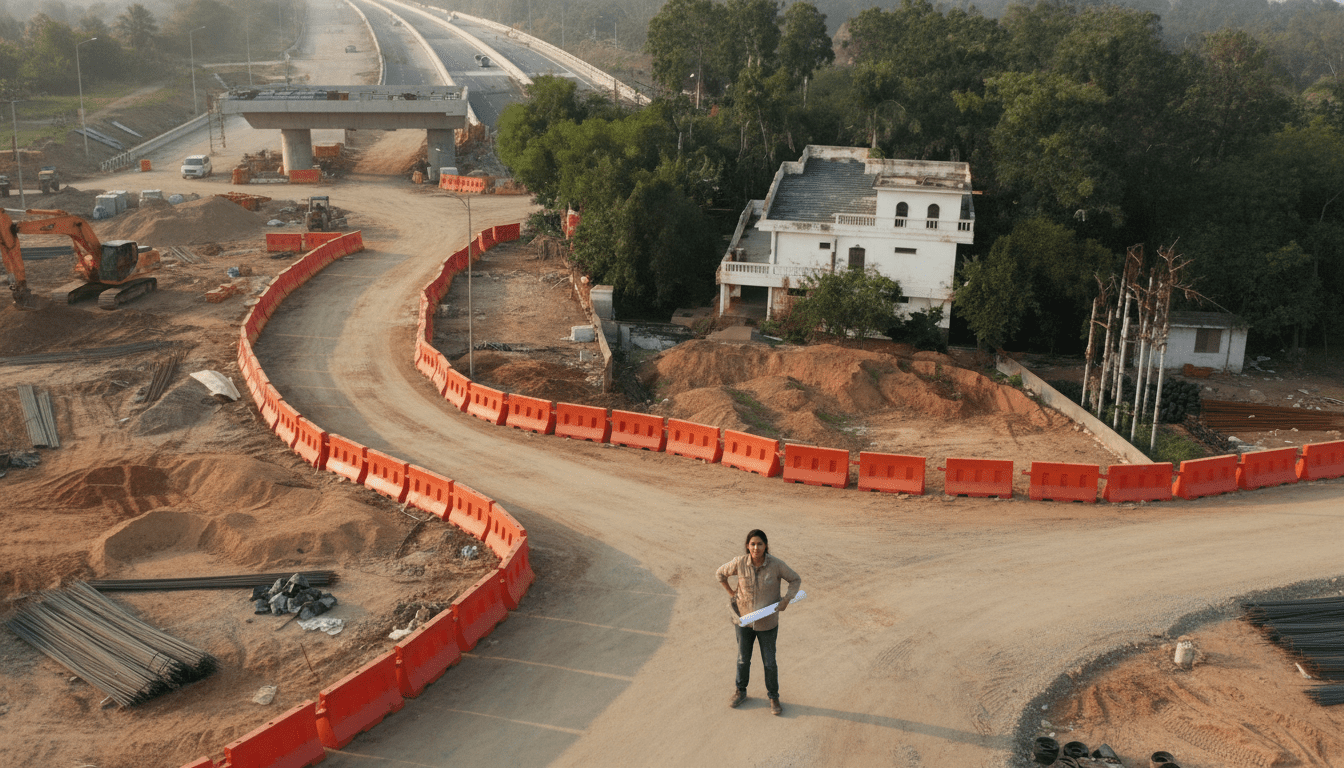
The property, sitting squarely in the middle of Ramp-5, belongs to the Saroha family. The standoff dates back to 1998 when the UP Housing Board originally acquired land for a housing scheme at roughly ₹1,100 per square metre. The late Veersen Saroha challenged the acquisition and secured a high court stay on his 1,600 sq m plot. Today, his grandson Lakshyaveer Saroha and niece Pooja Nehra continue the legal battle. The family is not against the highway; rather, they demand that compensation be updated to current 2026 market rates instead of 1998 values. This delhi-dehradun expressway guided tour illustrates the complexity of land acquisition.
Because the matter remains sub judice in the Lucknow bench of the Allahabad High Court, NHAI was forced to build crash barriers around the house and route traffic through a narrow, dusty temporary service road. A lone watchman guards the home day and night, standing as a stark reminder of the complex human elements involved in executing a massive ₹12,000 crore mega-project, a unique stop on any delhi-dehradun expressway guided tour.
“Under the leadership of Prime Minister Shri Narendra Modi, road infrastructure is being developed faster, safer and more sustainable than ever before.” – Shri Nitin Gadkari, Union Minister for Road Transport and Highways.
“Large-scale compensatory afforestation has been carried out in both Uttarakhand and Uttar Pradesh to compensate for the forest land diverted… The corridor will reduce human-wildlife conflict and promote safe and smooth movement of animals.” – Subodh Uniyal, Uttarakhand Forest Minister.
Data Table: Delhi-Dehradun Expressway FASTag Toll Rates
Understanding the financial cost of your journey is just as important as knowing the Delhi to Dehradun travel time. Here is the anticipated breakdown of FASTag toll rates for various vehicle categories traversing Phase I and Phase II as part of this delhi-dehradun expressway guided tour:
| Vehicle Category | Phase I Toll (Akshardham to Baghpat EPE) | Phase II Toll (Baghpat EPE to Latifpur) | Total Estimated Toll |
|---|---|---|---|
| Cars / Jeeps / Light Motor Vehicles | ₹240 | ₹190 | ₹430 |
| Light Commercial / Mini Buses | ₹385 | ₹310 | ₹695 |
| Two-Axle Buses / Trucks | ₹810 | ₹645 | ₹1,455 |
| Three-Axle Commercial Vehicles | ₹880 | ₹705 | ₹1,585 |
| Multi-Axle Vehicles (4-6 Axles) | ₹1,265 | ₹1,015 | ₹2,280 |
| Oversized Vehicles (7+ Axles) | ₹1,545 | ₹1,235 | ₹2,780 |
(Data sourced from NHAI tentative rates for the Delhi-Dehradun Economic Corridor and this delhi-dehradun expressway guided tour research.)
Unique Insight: The “Suburbanization” of the Himalayas
An incredible psychological phenomenon is taking place as a direct result of the Delhi-Dehradun Expressway. We are witnessing the rapid “suburbanization” of the Himalayan foothills. Geographically, the mountains have not moved an inch. Yet, by compressing the Delhi to Dehradun travel time to just 2.5 hours, the mental barrier separating the urban grind from alpine serenity has evaporated. This delhi-dehradun expressway guided tour explores this shift.
Historically, Dehradun was a distant retreat. Today, a corporate executive in Gurugram can realistically view the Sahastradhara Road in Dehradun the same way they view a plotted development in Noida-as a commuter-friendly residential option. This drastic time compression means that hill stations are no longer exclusively vacation spots; they are rapidly becoming extended suburbs of the NCR. While this is fantastic news for real estate portfolios and spontaneous travelers, this delhi-dehradun expressway guided tour notes it places immense pressure on the fragile ecology of Mussoorie and Rishikesh, forcing local authorities to navigate the tension between welcome revenue and environmental carrying capacity.
FAQs
How much time does it take to travel via the Delhi-Dehradun Expressway?
With the opening of the Delhi-Dehradun Expressway, travel time has been drastically reduced from over six hours to approximately 2.5 hours under normal traffic conditions, a fact verified by this delhi-dehradun expressway guided tour.
Are bikes and scooters allowed on the Delhi-Dehradun Expressway?
No. Two-wheelers, auto-rickshaws, tractors, and non-motorized vehicles are strictly banned from the high-speed elevated corridors to prevent accidents. Violators face fines of up to ₹20,000, as explained in this delhi-dehradun expressway guided tour.
What is the speed limit on the Delhi-Dehradun Expressway?
The maximum speed limit is strictly enforced by cameras. It is set at 100 km/h for cars and light motor vehicles, and 80 km/h for heavy commercial vehicles.
Are there petrol pumps or rest areas on the Delhi-Dehradun Expressway?
Currently, wayside amenities are still under construction. There are virtually no operational petrol pumps or CNG stations on the main elevated greenfield stretches. This delhi-dehradun expressway guided tour highly advises commuters to fuel up before entering the expressway.
What is the wildlife elevated corridor on the Delhi-Dehradun Expressway?
As part of this delhi-dehradun expressway guided tour, it is defined as a 12-kilometre elevated stretch of the highway passing over the Rajaji Tiger Reserve. Built at a height of six to seven metres, it allows wild animals like elephants and leopards to migrate safely underneath the road.
How do I pay tolls on the Delhi-Dehradun Expressway?
The entire corridor utilizes a closed tolling mechanism, meaning you are only charged for the exact distance you drive. All toll plazas are strictly FASTag-enabled, and cash payments are practically eliminated to prevent queues.
Does the Delhi-Dehradun Expressway go all the way to Mussoorie and Rishikesh?
The main expressway terminates near Dehradun. From the Dehradun exit, you will transition to regular, winding hill roads. However, because the highway cuts the plains journey so drastically, a full Mussoorie Rishikesh trip is now significantly shorter, with Mussoorie taking roughly 4.5 hours from Delhi. This delhi-dehradun expressway guided tour helps plan that connection.
Conclusion & CTA
The completion of the Delhi-Dehradun Expressway is a watershed moment for infrastructure in North India. By merging world-class engineering with profound environmental mindfulness, this 210-kilometre corridor does more than just pour asphalt; it bridges the gap between chaotic urban living and the tranquility of the Himalayas. Whether you are an investor looking to capitalize on the booming real estate market, or a weary city dweller planning your next Mussoorie Rishikesh trip, the mountains are calling louder—and closer—than ever before through this delhi-dehradun expressway guided tour.
Are you ready to experience the thrill of reaching the hills before your morning coffee gets cold? Ensure your FASTag is loaded, pack your bags, and take the drive down the Delhi-Dehradun Expressway this weekend! Drop a comment below and share your experience regarding the scenic wildlife elevated corridor. Don’t forget to share this delhi-dehradun expressway guided tour with your travel buddies to plan your next mountain escape!
Related Articles:
- Travel to Tungnath: 7 Ultimate Tips for the Perfect Trek
- The Ultimate Varkala Travel Guide: Discovering Kerala’s Cliffside Paradise
- A Soulful Guide to Munnar: Budget, Hidden Gems, and the Magic of the Mist
Here are the properly hyperlinked sources used to compile the article:
Sources: